Home > Appointment
Our process keeps hernia care clear and organized, beginning with focused assessment, followed by a personalized treatment plan, and continuing with practical recovery guidance carefully tailored to your individual needs.
Schedule your consultation and share your symptoms, medical history, previous surgery details, and any available scans or reports.
Your surgeon evaluates the hernia, explains suitable treatment options, and discusses expected benefits, risks, alternatives, and recovery considerations.
After treatment, follow personalized recovery instructions, attend recommended reviews, and contact the clinical team if concerning symptoms develop.
Book a Lahore consultation to discuss symptoms, diagnosis, treatment choices, recovery, and appropriate next steps with our team.
Find answers to common questions about hernia symptoms, diagnosis, laparoscopic treatment, surgery, and recovery at Hernia Management Center in Lahore.
A hernia occurs when an internal tissue or organ pushes through a weak area in the surrounding muscle or abdominal wall. Common symptoms include a visible bulge, discomfort, heaviness, pressure, or pain that may become more noticeable while standing, coughing, lifting, or straining.
Not every hernia requires immediate surgery. Treatment depends on the type of hernia, its size, symptoms, overall health, and the risk of complications. A specialist assessment can help determine whether monitoring or surgical repair is the most appropriate option.
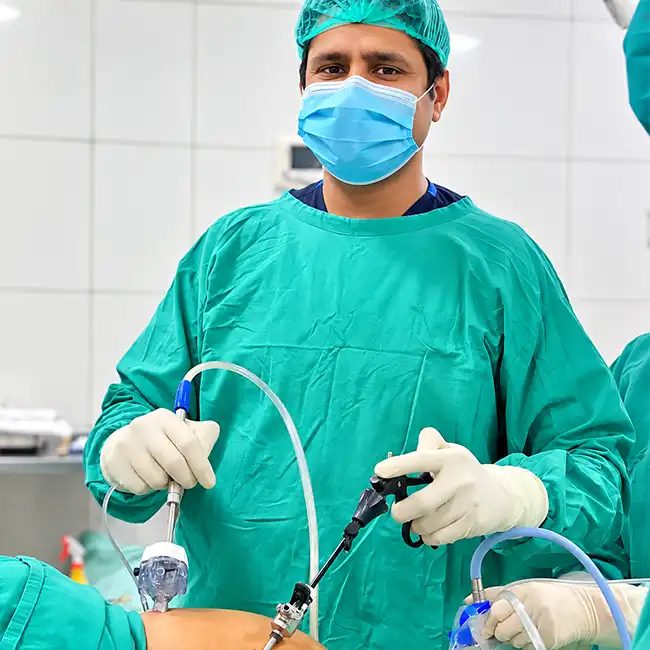
Yes, many types of hernias can be treated using laparoscopic or minimally invasive surgery when appropriate. Laparoscopic hernia repair uses small incisions and a camera to perform the procedure. The most suitable technique depends on the type of hernia, previous surgeries, anatomy, and the patient's overall condition.
Recovery varies depending on the type of hernia, surgical technique, and individual patient factors. Many patients are encouraged to start walking soon after uncomplicated surgery and gradually return to normal activities. Your surgeon will provide specific instructions regarding work, lifting, exercise, and follow-up.
Seek urgent medical care if a hernia suddenly becomes very painful, hard, swollen, discolored, or cannot be pushed back in, especially if accompanied by vomiting, abdominal swelling, fever, or difficulty passing stool or gas. These symptoms may indicate a complication requiring immediate assessment.
Receive new hernia education, recovery guidance, and clinic updates to support informed healthcare decisions for patients across Lahore.
Contact Hernia Management Center Lahore | Book Consultation
Hernia Managment Center - Lahore.
Copyright © 2026. All rights reserved.